Communication – or maybe just sound and fury

There’s something happening here. What it is – not exactly clear. There’s a guy with a phone over there, telling me – what? Do I need to beware?

.

He could be doing almost anything with that phone – texting, reading, working, shopping, watching a movie, setting the thermostat at home, checking on his pets..

He might as easily be scamming, catfishing, trolling, hacking, spreading conspiracy theories, committing hate crimes.

But is he using that phone to actually talk to anyone?

Within the relatively short time frame of my adult life, the expansion of communication technology has significantly changed the way the world goes about its daily business. Sure, things like TV, satellites, telephones and computers, and even a fledgling internet existed long before I was on the scene, but for about 100 years all of those ingenious ways of creating person-to-person connections and transmitting information changed and improved and gained popularity, gradually coming together like a technological snowball, building up mass and speed as it rolled over the world in a massive avalanche.

When that avalanche hit, it provided us with the ability to see and hear events around the world as they happen. To easily talk face-to-face with people no matter what country they’re in – or even if they’re in space.

But if you need stuff and you’re not in the mood for talking, pretty much anything you need can be chosen, purchased and delivered directly to your home without you needing to interact with anyone.

Instead of standing in line hoping to get tickets for current movies or making sure we’re at home when our favorite TV shows are on, we can stream whatever we want to watch whenever and wherever we want to watch it.

We’re no longer at the mercy of radio stations, listening to whatever music they deem worthy of airtime, but can listen to our favorite songs from any time period, shuffling them into whatever type of playlist we want. And instead of waiting and hoping for a rare appearance by our favorite band on a TV variety show, we have our choice of platforms to see their performances anytime. We can keep up with their activities on social media and even leave comments for them.

Entering a few words into Google will get us information when we need it. And for serious fact-finding, remote access to academic or scientific databases allow for research and collaboration without necessarily traveling to a library or lab. But if you do find you need to travel, all you need is the address – there’s no need to ask for directions or keep a road atlas in your car.

All of these changes are huge on their own, but the fact that we can do it using something we can carry around in a pocket – it still seems a bit magical to me. And I doubt if I’m the only one who feels that way – remember Back to the Future: Part II? In 1989, the filmmakers imagined a 2015 with flying cars and self-tying shoes, but when Marty McFly’s son needs to call someone when he’s out and about, he has to find a phone booth. They do have a video phone at home, but it’s gigantic, mounted on the wall and attached to a fax machine.

I’ve become as reliant on all of these technological conveniences as anyone else and I know there’s no going back, but I wonder even now – are we actually ready for it all? Perhaps more importantly, though a bit late to contemplate – is it even good for us?

As much as I love having information at my very fingertips and multiple forms of entertainment on demand, I sometimes miss the specialness of waiting and planning for a TV show or movie that I know only comes on once a year, or the excitement of seeing a favorite performer in a rare TV appearance. But I don’t miss it enough to give up on the instant gratification provided by connectivity. Still, I sense that the easier it becomes to express our own ideas, the worse we become at taking the time to understand what others are thinking.

It seems like it should be useful and positive, this ability to learn about people and events around the world in real time. Unfortunately, ability to spread information and ideas quickly is not necessarily connected with reliability. But sometimes it’s just too easy to see or hear something and assume it’s true, to believe that people are being honest. Who has the time to check sources for everything? If information is sensational, shocking, humiliating or nonsensical, it may well go “viral” – a word that for its first 50 years of use implied the spreading of disease, a meaning that is uncomfortably appropriate when applied to some widespread messages/videos.

The ease with which we accept viral news, no matter how unsubstantiated, is nothing new. The sentiment that “there’s no smoke without fire,” implying that any bit of juicy gossip must have some truth behind it, was recorded as early as the 14th century. Just because we can hear about more information more quickly than we could 700 years ago, doesn’t mean we have to be any more thoughtful about the dangers of handling it carelessly.

Depending on how much you put yourself out there, your comments on social media might be seen by what – hundreds? thousands? millions? Comments that maybe should be made face-to-face to one or two people, whose reactions you could see and hear immediately, giving you a sense of how your message is coming across. But it’s just too easy to comment from a distance, to have the freedom to make your point when you want to, without anyone interrupting with their own observations and opinions.

And if anyone does object to what you’re saying, you can search for and find a space with like-minded people, folks who share your concerns. A space where you can exist in a bubble of agreement and remain convinced that you’re right and those who disagree with you are wrong.

Or you can be like me and hide from social media to avoid crossing the battle lines being drawn, at this time when the US is divided not-very-neatly in half, with each half refusing to accept that the other half might be right about anything. And if nobody’s right, then everybody’s wrong. I’m very much afraid that’s what we’re stuck with, no matter what happens politically in the coming months.

I may have seen amazing advances in communication technology in my lifetime, but it seems unlikely I’ll live long enough to see us learn how to use it to really understand and appreciate each other.
Talkin’ ’bout my generation

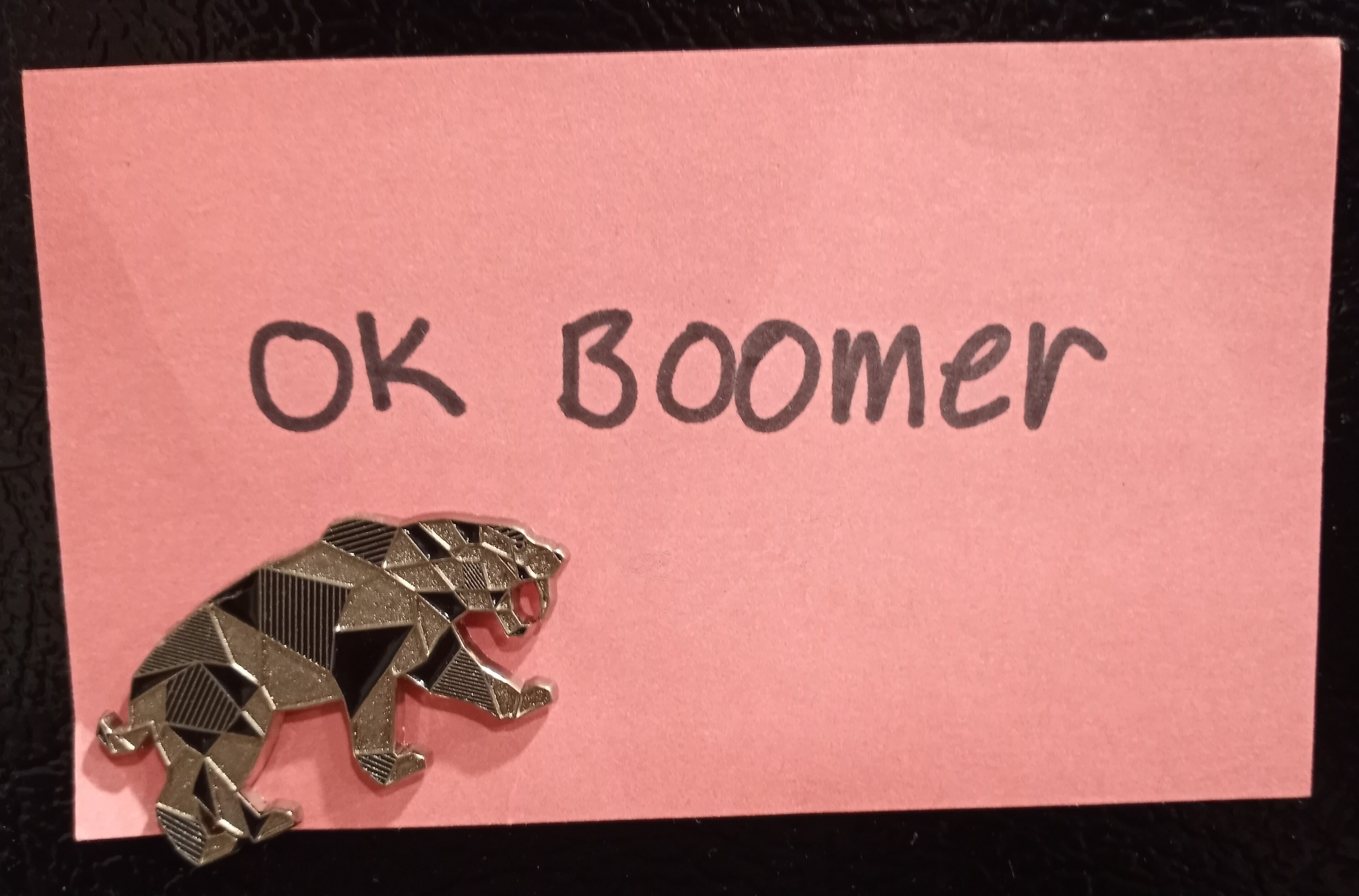
I was first introduced to the phrase OK Boomer a few years ago during a museum visit with our Gen Z daughter. I have no recollection what my husband said to bring it on – but it was at the very least, a “dad” type of comment. After he said whatever it was, our daughter handed him a slip of paper with “OK Boomer” written on it. It was from one of her friends who was unable to accompany us on this particular trip, but she didn’t want to miss the chance to insert the gibe when the appropriate chance presented itself – as she was sure it would.

We thought it was quite funny. Even stuck it on the fridge with a magnet we bought at the museum. An acknowledgement of our shift into becoming, while not yet the oldest folks around, firmly part of the grandparent crowd. We get it. Taking a poke at someone in a different generation is traditional, expected – possibly mandatory. It’s been going on for millennia – basically as long as there has been more than one generation.

Sometimes “OK Boomer” goes through my own head in response to things I hear my contemporaries say or do. Sometimes because it’s funny; sometimes not so much. Occasionally it strikes me that I deserve an “OK Boomer”, a friendly reminder that maybe I should think again about my reaction to a situation. Are my perceptions based on out-of-date information or resistance to change? Have I simply not been paying attention to things? Or is my assessment appropriate but I need to find a fresh way to communicate my thoughts?

When it comes down to it, I think we all need some type of prompt to make us think about things before reacting in frustration or anger. And I don’t think that’s just a grandma type of attitude – since childhood I’ve been more of a can’t-we-all-just-get-along kind of person. Of course long before I reached the grandma stage, I understood that everyone getting along was never going to happen. But a Boomer can still dream.

I actually kind of like the sound of OK Boomer – it’s such a catchy phrase (though it’s good that the “Baby” part was easily dropped – we’re a bit past that). OK Gen X or OK Silent Generation doesn’t roll off the tongue quite as easily. Makes me wonder what phrases Generations Alpha and Beta will come up with to goad their elders.

It could be something similar to OK Boomer, using an expression that might, on the surface anyway, be interpreted as a positive. (Are you feeling OK Boomer?; Hey, you’re really OK Boomer.) But when said with a dismissive tone, a certain drawing out of the words, the phrase has more of an I’m-OK-you’re-definitely-not-OK implication. Maybe in 20-30 years they’ll say something like Exactly, Gen X; Meanwhile, Millennial; Amazing, Gen Z.

But I suppose the Alphas and Betas will figure such things out for themselves. And they will do it. It’s more or less a birthright – they were born, so they have a right to complain about the people who have been running things, telling them what they should or shouldn’t do. And by the time they’re old enough to question their elders, the Boomers will be a bit too elder to bother with, so they’ll direct their comments toward their own parents and grandparents.

When we Boomers were growing up, the derogatory phrase was a bit longer but still memorable, easy to latch onto: Never trust anyone over 30. Actually a bit harsher than something like OK Boomer, applying to pretty much anyone in charge of anything.

Newsworthy in 1968

And maybe we were a bit harsh in our reactions to the powers that be. According to a Wikipedia entry I just read, the Boomer generation drove social scientists to develop a whole new theory about the “generation gap” because us darn kids seemed determined to like whatever our parents didn’t like, or not like what they did like – whether it be music, core values, political views, cultural tastes, clothing styles, hair length – whatever. The term “generation gap” was used so often when I was young that I assumed it had always been a well-known concept. I didn’t realize I was part of creating it.

Not that I believe we are responsible for inventing the generation gap. I’m sure it was always there – but maybe there were just so many of us all at once that the need for some sort of bridge was more obvious.

And so here we are, now on the far side of that gap. Not sure if that means we somehow crossed a bridge or if a chasm developed behind us while we were looking the other way. At any rate, we’re now old enough to mistrust our own over-30 children.

In 2019, The New York Times published an article titled, “‘OK Boomer’ Marks the End of Friendly Generational Relations.” According to this article, it sounds like Boomers may have started the fight, with your basic “kids these days” rants, basically complaining that teenagers and young adults are, well…..young. And they have the nerve to be doing things differently from the way their parents and grandparents did them. Such rants are made all the worse because they’re not just shouted from the front porch at kids in the neighborhood – they go viral on social media and are essentially shouted at any young person with a phone.

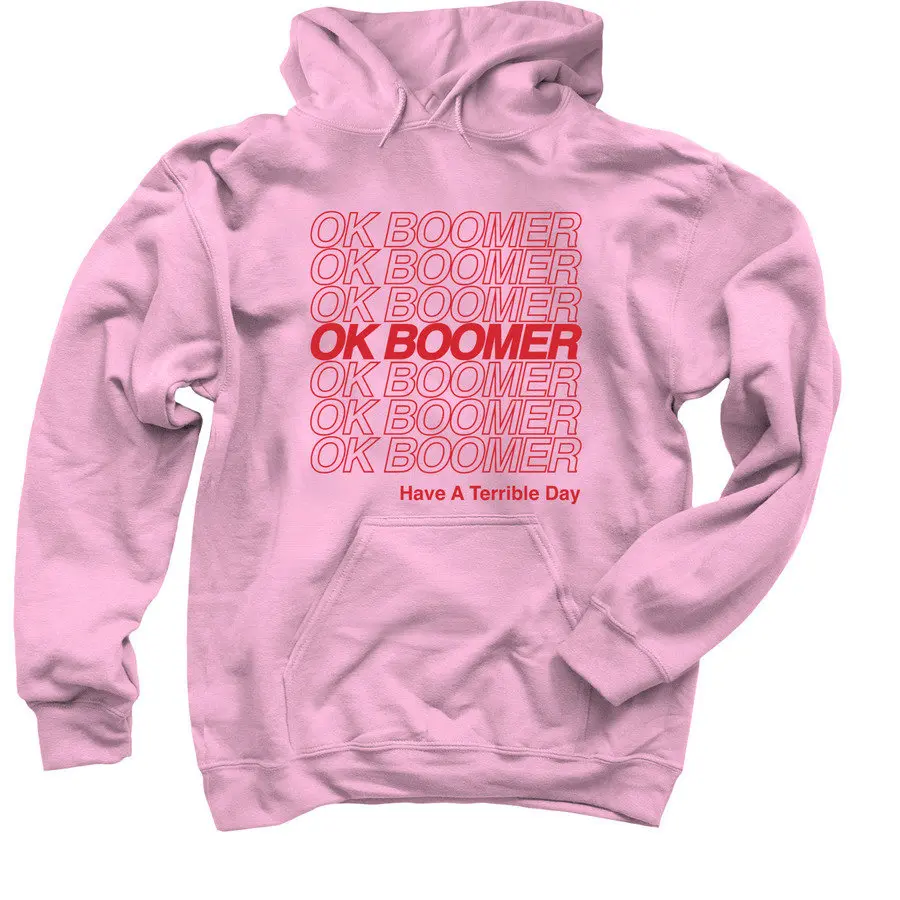
So Gen Z-ers got creative and entrepreneurial, and retaliated by putting their snappy phrase on t-shirts, sweatshirts, hats and other merchandise to make sure older folks know, “You’re not the boss of me.”

One quote from a 19-year-old grabbed my attention, mainly because with minor wordsmithing, it reads exactly like something that might have appeared in that Life magazine article from 1968, when many Boomers were teens:

“The older generations grew up with a certain mindset, and we have a different perspective,” Ms. O’Connor said. [all young people of every generation said]. “A lot of them don’t believe in climate change [civil rights/women’s rights/getting out of Vietnam] or don’t believe people can get jobs with dyed hair [long hair] and a lot of them are stubborn in that view. Teenagers just respond, ‘Ok, boomer.’ [Chill out man] It’s like, we’ll prove you wrong, we’re still going to be successful because the world is changing [the times, they are a-changin’].”

I’m not sure whether I’m saddened or encouraged by the fact that generation-based gripes never really change.

It seems natural for younger generations to want to shake things up a bit, to have new ideas, to see a different way forward. To know that they see things that their elders don’t see and to be confident that their changes will benefit society, improve the world. Such an attitude may be hardwired into our brains, triggered by adolescent hormonal changes. An evolutionary advantage perhaps – survival of the surest.

It seems natural for older generations, who have done their share of shaking things up and have been shaken in return, to be wary of new ideas. Innovation is great, but experience has taught us that the results are not always what we expect or hope. Dreams keep us going, but past bumps and bruises remind us to keep our eyes open during the pursuit. We learn to roll with the changes, but sometimes wish that the boat didn’t rock quite so much as we try to maintain the balance we’ve worked for. Another evolutionary phase – survival of the cautious.

It seems it should be natural for younger and older generations to listen to each other, take time to learn from each other. To be reminded of the excitement of jumping into something new, or to seek insight from an experienced someone before taking a leap. But it seems the middle ground is often too shaky for holding long conversations.

Back in that Wikipedia article, I learned that instead of a generation gap, social scientists now talk about “institutional age segregation” – which just sounds way too dystopian to me. The phrase is intended to communicate the idea that members of a particular generation tend to stick together, physically separating themselves from folks of other generations, limiting opportunities for interaction across age barriers, at least outside their own households.

And if the only cross-generational interactions we have are with our own family members or via social media rants, then maybe dystopia is not too far off the mark.

I admit I don’t always see the attraction of some of the things Gen Z finds entertaining. I don’t always get their jokes. I don’t always understand the point of a lot of memes/vines/reels/whatever. But I also don’t expect Millennials or Gen Zs to necessarily have the same perceptions of current events that I have. I don’t expect or even wish that they will approach adulthood the same way I did. They were born into a world changed by technology that was really just ramping up well after I was over 30. Gen Z’s fluency in current cultural and linguistic norms goes well beyond familiarity with trends or slang – it’s part of who they are. They are native speakers of a language I learned as an adult.

My husband and I raised two kids – one Millennial and one Gen Z. I count them and several of their friends as my own friends. From what I can see, they take their adulting very seriously. Quite possibly more seriously than I did when I was their age. Generationally speaking, what I’m hearing them say is that everyone should have a voice and should be allowed to find their own best path as they navigate adulthood and the world at large.

With the history we’ve lived through, how can Boomers argue with that?

Disney has convinced us that we live in a small, small world, but it seems to me it’s quite big enough to be going on with. We are confronted with this big old world in a more up-close-and-personal way than ever before, and at the same time, we’re distancing ourselves from people right next to us.

I agree that everyone should have a voice – no matter how old or how young that voice is. But we can’t make sense of those voices unless we listen.